

Internal Family Systems with Jana
Do you feel that one part of you is pulling you forward and the other is holding you back?
I help people cultivate a kinder relationship with their inner parts using the Internal Family Systems (IFS) method, also known as "parts work."
Together, we explore anxiety, shame, the inner critic, relationship patterns, self-doubt, or whatever keeps you feeling stuck. We make space for every part of you with curiosity and compassion.


IFS Level 2 Practitioner


About Me
My name is Jana, and I work as an L2 IFS Practitioner. I know firsthand what it’s like to have parts of oneself that feel shameful or that one would prefer to ignore and just how draining and distracting that can be.
That is why I create a space where there is no need to pretend or to feel ashamed of anything.
About the Method
What is IFS? (Internal Family Systems)
You might know that voice in your head that says:
"You're not good enough."
"You messed up again."
"If others knew who you really are, they would reject you."
"You have to be perfect, otherwise you'll fail."
"You'd better shut up - what if you say something stupid?"


Or perhaps you know the feeling when:
anxiety grips you and your body tenses up before an important meeting or conversation
you make a mistake and immediately sink into shame
you can't say no, even though you know you should
you avoid things you want because you fear failure or rejection by others
after a conflict, you replay the situation over and over, punishing yourself for what you said or didn't say


What are parts?
In IFS, we call these voices and feelings "parts." The inner critic, the anxious part, the part that feels shame, the part that protects you by holding you back—none of them is your enemy. Each one emerged for a good reason and seeks to protect you from rejection, pain, or disappointment you experienced in the past.
In sessions, we do not learn to fight these parts. Often, these parts have been forced to take on extreme, unnatural roles due to past trauma. Instead, we connect and communicate with them, offering them attention and care.
We learn to listen to them, understand them, and gradually build a safer relationship with them. When they feel heard, they often no longer need to be so loud, allowing you to experience greater calm, self-acceptance, and inner freedom. There is no such thing as a "bad" part; all of them deserve attention and kindness.


What does a session look like?
We will begin by discussing what brings you here. During the session, I will gently guide you in connecting with your inner parts, such as your inner critic, an anxious part, or the part that tries to keep everything under control. We will get to know them without judgment and discover what they need.
No prior experience with IFS is required.


Do you want to learn about IFS ?


IFS Basics: 40-Minute Workshop
I have prepared a free 40-minute theoretical workshop on IFS and four guided meditations for you, allowing you to try working with parts yourself and establish an initial connection with your inner parts.
“You know what you need to do.
Or maybe everything feels so overwhelming you don’t know where to start.”
Not because you’re lazy or broken —
but because parts of you don’t feel safe yet.
You try to push through, stay productive, do all the right things.
But under the surface?
There’s a part of you that’s still terrified to mess it up, get it wrong, or let someone down.
That’s not a motivation problem.
That’s younger, vulnerable part of you pulling the handbrake — right when you’re about to take action — because they don’t feel safe yet.
And no productivity hack will fix that — because it was never about willpower. It’s been about safety.
I help thoughtful, introspective people untangle that fear and rebuild self-worth from the inside out — using IFS and EFT.
Get 20% off your first 1:1 session
→ Let’s meet the part gently.
You want to make more money —
but every time you think about charging more, you avoid it.
You know you should apply for better jobs —
but you stay where you are because it feels safer.
You want to be seen for your work —
but posting, presenting, or sharing feels exposing, so you hold back.
You had big plans for your life — and now quietly think,
“This is not where I thought I’d be by now.”You want to speak more freely — but in important moments your voice tightens
or your mind goes blank. You’re capable — but when it matters most, you don’t act like it.
Does this feel familiar?


Why Moving Forward Feels Harder Than It Should
You want things to change.
In work, money, or life.
But moving forward feels harder than it should.
You think about it.
You plan.
You know what you should do.
And yet, when it’s time to act,
you hesitate, pull back, or get stuck —
and somehow end up in the same place again.


What Working w/ Me Looks Like
If you’re tired of being told to “just do it,” this will feel different.
You already know what you want. You’ve read the books.
Watched the videos. Made the plans.
But when it’s time to send the email, ask for money, apply, post,
or speak up — you don’t.
You open the laptop… and suddenly feel tired.
You write the message… and delete it.
You tell yourself you’ll do it tomorrow.
We don’t force action. We don’t push through fear. We don’t hype you up. We look closely at what happens right before you stop.
The hesitation. The tension.
The inner voice that says“Not now.” “It’s risky.” “Wait.”
When that reaction is understood — not overridden — movement becomes possible again.


This is why pushing harder hasn’t worked.
And why productivity tools only help for a while.
You’re not fighting a lack of discipline.
You’re meeting a protective system that hasn’t felt safe yet.
Once this makes sense, the self-blame can stop.
Why this matters
What’s really happening
You don’t avoid action because you don’t care.
You avoid it because a part of you learned that trying can be dangerous.
Dangerous might have meant: being criticized, getting it wrong, disappointing someone, losing connection, being seen.
So when you’re about to take a step forward, that part steps in.
It slows you down.
Distracts you.
Makes you doubt yourself.
Pulls the handbrake right when momentum starts to build.
Not to sabotage you.
But to protect you.
From its point of view, not acting feels safer.
When you stop fighting yourself:


• decisions feel clearer
• confidence feels steadier
• speaking up feels safer
• money feels less emotionally charged
• action feels possible instead of draining
Not because you tried harder —
but because the inner conflict softened.

About Me
I don’t push you to change.
I don’t try to fix you or motivate you to be someone else.
Our work starts by slowing things down.
Together, we pay attention to the moments where something in you pulls back —
before speaking up, asking for more, being seen, or taking the next step in your relationship.
Not to get rid of these parts, but to understand what they’re protecting.
I work with parts of you that learned to stay quiet, incapable, or “good”.
We meet them with understanding, not pressure. And we help them.
This is not about becoming more confident on the outside.
It’s about rebuilding trust on the inside.
When your parts start to feel understood, movement happens naturally.
I’m a Level 2 Internal Family Systems (IFS) Practitioner and a Clinical EFT Practitioner.
My work is grounded in trauma-informed, parts-based approaches, with a focus on shame, anxiety, self-worth, and expression.
QUALIFICATIONS
Methods I use

IFS
We all know situations in our lives when we feel like one part of us wants to do this, but another part wants something completely different. Or perhaps you wish you would have some characteristics/ or wish a personality trait or behavioral pattern would go away?
IFS (Internal Family System Model) is based on idea that we are made up of multiple sub-personalities/parts, each with its own unique viewpoints and qualities and its normal. These sub-personalities/parts are often pushed to fulfill extreme, unnatural roles based on past trauma.
EFT
Work through emotional trauma from childhood, birth trauma, conception, ancestry, and even past lives with Clinical EFT (Emotional Freedom Technique). We use the EFT tapping on meridian pathways to rewire our brain, adding new connections and cutting off the neural pathways that no longer serve us.
For example, tapping on acupuncture points soothes the body and sends a signal of safety to our limbic part of the brain. The limbic system usually responds to the physiological signal of safety, overrides the psychological signal of danger, and produces delta waves (relaxation and deep sleep waves).
As a result, the conditioned loop is broken, and we are rewiring the subconscious mind (powerful information processor that runs automatic, often undesirable program behaviors).
Let's meet what's stopping you
If you’re tired of forcing yourself and want to understand what’s really happening inside, we can work together.
We’ll meet the part that pulls the brakes — gently, respectfully, and without pressure.
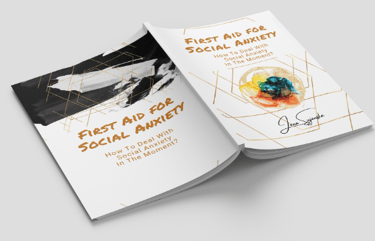
My Book
First Aid for Social Anxiety
How to Deal With Social Anxiety in the Moment of Trigger?
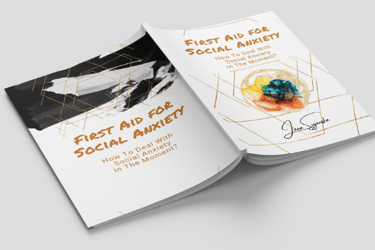
First Aid for Social Anxiety
How to Deal With Social Anxiety in the Moment of Trigger?
This book grew out of the same work you’ve been reading about here.
It’s for moments when anxiety, shame, or self-doubt take over — especially in social situations, conversations, or moments of visibility.
You can use it when anxiety hits, it has been written based on my personal struggles with anxiety.
It doesn’t try to fix you or push confidence.
It helps you understand what’s happening inside you and it offers very practical tool you can apply even in the moment of trigger, on the spot, in social or any other situations.
You can start here.
1:1 Sessions Available
1:1 Sessions Available
Discovery Session


Discovery Session


Offer 1:1 IFS sessions
Single IFS session
(60 min)


First session
Package of 3 IFS sessions
(60 min)
A series of 3 sessions for deeper work with your parts.
Package of 5 IFS sessions
(60 min)


A series of 5 sessions for deeper work with your parts.
Once a week
Once every 2 weeks
Offer of 1:1 IFS sessions
Introductory IFS session
(60 min)
First session
Package of 3 IFS sessions
(60 min)
A series of 3 sessions for deeper work with your parts.
Package of 5 IFS sessions
(60 min)
A series of 5 sessions for deeper work with your parts.
Once a week
Once every two weeks28
Client Testimonials
"I was new to IFS and didn't know what to expect. Thanks to Jana's calm and kind energy, I was able to connect with parts that had a lot to tell me—parts I otherwise would never have discovered. I left with a deeper self-awareness than I had ever known before."
Stephanie
If you were satisfied with the session and would like to leave a review, I would greatly appreciate it. You can also leave a review anonymously.
Inspiration On Social Media
Tag #partsworkchick to be featured on Instagram
Inspiration On Social Media
Tag #partsworkchick to be featured on Instagram
TESTIMONIALS
I had 2 sessions with Jana and they were both very insightful! I am new to IFS so wasn't sure how the sessions would go but because of Jana's beautiful energy and calm, compassionate presence, I was able to connect with many parts of myself. It turns out they had a lot to say! This modality is wonderful for gaining awareness and information into the conflicting parts that we otherwise might never recognize. Jana talked me through the process with a kind heart, intuitive wisdom, and held a beautiful space for me to comfortably go inward. I highly recommend getting some sessions with her. You will be so glad you did and will come away knowing yourself in a way that you didn't before.
Stephanie H.
TESTIMONIALS
I had 2 sessions with Jana and they were both very insightful! I am new to IFS so wasn't sure how the sessions would go but because of Jana's beautiful energy and calm, compassionate presence, I was able to connect with many parts of myself. It turns out they had a lot to say!
This modality is wonderful for gaining awareness and information into the conflicting parts that we otherwise might never recognize. Jana talked me through the process with a kind heart, intuitive wisdom, and held a beautiful space for me to comfortably go inward.
I highly recommend getting some sessions with her. You will be so glad you did and will come away knowing yourself in a way that you didn't before.
Stephanie H.
Wanna know what's new?
We will keep you updated with new blog posts, tips and guided meditations.
Wanna know what's new?
We will keep you updated with new blog posts, tips and guided meditations.
Get in touch


Get in touch